This post was written by James R. Swensen, a BYU Humanities Center faculty fellow.
Just so you know, it takes about a week (or so) to recover from a study abroad program, even when everything goes smoothly. Having directed and co-directed several programs, my family and I have learned that once the students have left, we need to run off and recover. Moreover, having experienced a plethora of museums and churches, my family wants absolutely nothing to do with art, which is understandable. This last summer (Spring Term 2025), after our art history program ended in Copenhagen, we retreated to the idyllic island of Møn, roughly an hour south of the Danish capitol. We rented a small farmhouse off a long country road and blissfully decompressed.
Yet, as my family has learned (much to their chagrin), it is possible to find art and history nearly everywhere we go. The world for an art historian is a never-ending discovery of things to see and experience, a scavenger hunt of the remarkable. What we did not foresee when looking for an escape was that sylvan Møn was filled with incredible sights. We soon learned that we were surrounded by prehistoric dolmens and small Gothic churches which dotted the landscape. Upon entering the nearest church in Keldby, we encountered a vaulted ceiling that was filled with colorful and ornate Gothic frescoes. As I stood spellbound, my family knew that we were in trouble (Figure 1).
 Figure 1. Keldby Church, Denmark, 2025. Photograph by the author.
After Keldby, we tracked down other churches with similar frescoes in the hamlets of Elmelunde, Fanefjord, and Tingsted located on the nearby island of Falster.[1] The frescoes (or kalkmalerier in Danish) were created by a painter simply known as the Elmelunde Master and his studio; it was the striking church in Elmelunde where his work was first rediscovered. Although we do not know the name of the artist, his “signature” or monograph appears to be a quickly painted stick figure with what looks like the floppy hat of a court jester (Figure 2). This may be fitting as there are elements throughout the flowering frescoes that surprise, make one laugh, and uncloak important truths.
 Figure 2. Monograph of the Elmelunde Master, Elmelunde Church, Denmark, 2025. Photograph by the author.
The frescoes of the Elmelunde Master date to around 1505 A.D. and they survived because of their attempted destruction. When the Protestant Reformation swept across Europe, churches, large and small, were “swept clean” of their visual imagery, destroying paintings, sculpture, altars, and anything else that might be misconstrued as an idol. Iconoclasm reached Møn around 1536 when Denmark embraced Lutheranism. Thus, within decades of their creation, the work of the Elmelunde Master was whitewashed and banished from view. The church frescoes were rediscovered beginning in late 1870s when scholars began to remove the outer layers of paint to reveal the vivid paintings hidden underneath. Due to age and destruction, there are relatively few extant examples of Gothic architectural painting and so these frescoes were a significant discovery.[2] Indeed, there are few places in Europe where it is possible to gain a better sense of what Gothic paintings looked like and how they worked.
Most art in the Gothic age was not created to simply look pretty; rather, whether in the form of a massive cathedral or a small-town church fresco, Gothic art was, by and large, didactic and meditative; it was designed to instruct viewers to choose good over evil, heaven over hell. Seeing was to feel and learn. The Elmelunde Master, most likely with the instruction of church authorities, filled the vaulted ceilings with Biblical narratives illustrating scenes from the creation and the life of Jesus. Located near the altar, these scenes would have provided visceral illustrations for sermons, highlighting the paragons of virtue, namely Mary and her Son. Conversely, other figures like Adam and Eve, Sampson, David, and Judas illustrated the earthy and eternal consequences of wrong choices, acting like patron saints of bad decisions. At the far end of each church, the scene of the Last Judgement appears as the prime example of the ultimate ultimatum, the terminus of all our earthly decisions (Figure 3).
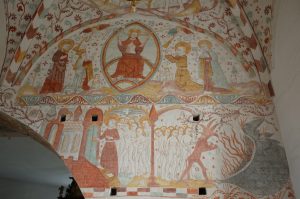 Figure 3. The Last Judgement, Fanefjord Church, 2025. Photograph by the Author.
As scholars have pointed out, these representations resemble the Biblia Pauperum or “Bible of the Poor,” a popular woodblock printed book that used biblical imagery and allusions to instruct a wide variety of audiences. In several ways, the frescoes do resemble the popular text in style and form. The figures are simple and direct. Like the popular blockbook, they also employ various typologies, types and antitypes, used to generate meaning.[3] This includes the juxtaposition of Old and New Testament accounts and figures, which required viewers to make their own spiritual connections free from the rhetorical and theological monopolies of the church.
Throughout the visual program of the frescoes, Jesus, who is shown as the Way, is often matched by demons and devils. The former was to inspire viewers, while the latter were presented to scare them into changing their ways. Often painted in vivid colors, the demons are hybrid creatures having the form of a man combined with bestial features like webbed feet, long snouts, claws, pointy ears, spiked tails, hooves, and horns. More animal than person, they are incapable of understanding what it means to be human. When Satan tempts Christ on the ceiling at Fanefjord, he appears as one of these terrible figures, fallen to a form beyond recognition. The same is to be said of the blood-red patron demon who plunges the damned to hell in the Last Judgement scene at the same church.
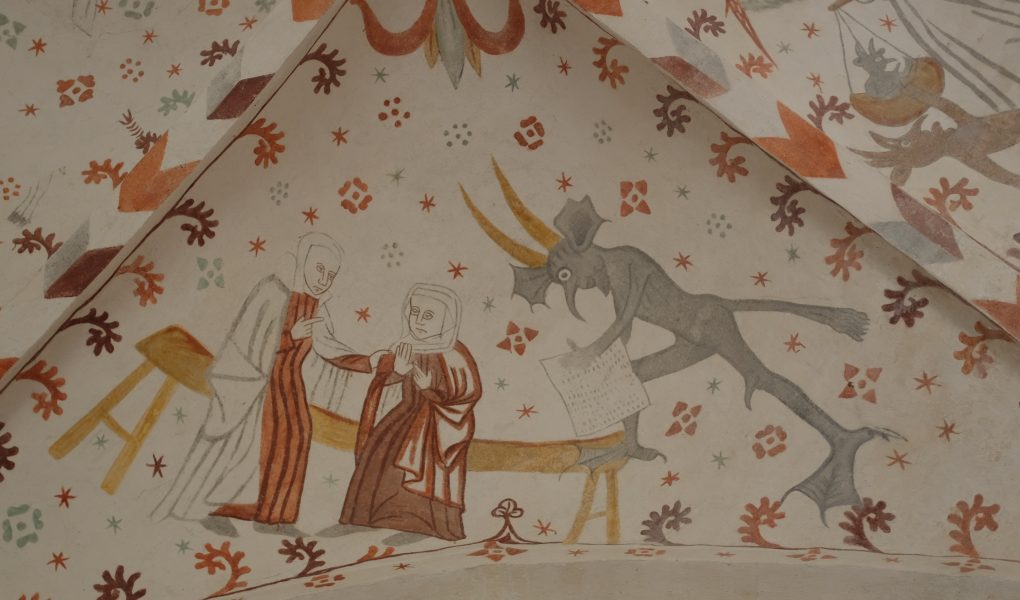
Some of the most intriguing scenes in these churches, however, appear a little further back in the nave, where the congregants would have knelt on the floor in supplication and prayer. Here, interspersed with biblical saints, are everyday people engaged in the same process of making good and bad choices. These scenes are not found in the Biblia Pauperum. Rather, they feature more earthbound experiences. In one example from Fanefjord, the horned demon Titivillus pesters two women in contemporary dress (Figure 4).[4] Among other demonic tasks, Titivillus’s job was to observe and record the names of those who slept during church services, mumbled or skipped lines of prayer, and/or engaged in gossip.[5] Here, he records the names of two women caught in the act of speaking ill about someone else.
 Figure 4. Titivullis and the Gossipers, Fanefjord Church, Denmark, 2025. Photograph by the author.
Some of the most remarkable scenes painted by the Elmelunde Master do not require a demon to emphasize the quality of decisions we make every day. On the ceiling of Tingsted located near the entrance, four figures are illustrated astride a multi-spoked wheel (Figure 5). This scene illustrates the “Wheel of Life.” It begins with the figure on the left who, in ascendence, proclaims in Latin, “Regnabo” (I will rule). A proud figure in elegant dress and a scepter in his hand sits astride the wheel and announces, “Regno” (I rule), while the next figure, now literally falling onto his head and barely able to hold on, states that he once reigned (regnavi). The last figure at the bottom, stripped nearly naked and crushed under the weight of the wheel, laments “Sum sine regno sic transit gloria mundi” (I am without a kingdom thus the glory of the world passes away). In this scene, whose message is familiar to Latter-day Saints, there are no demons rolling the pride cycle along. Rather, as it demonstrates, we do a good enough job of giving into pride without a push from a webbed hand.
 Figure 5. The Wheel of Life, Tingsted Church, Denmark, 2025. Photograph by the author.
For me, there is one image, repeated in each of the four churches I studied, that best illustrates the importance of our choices. Known as the “Good and Evil Prayer,” this scene is typically located near the entrance of the church, an upfront statement to everyone entering the sacred space (Figure 6). It features two men kneeling on each side of a bloodied and wearied Christ pitiably hanging on the cross. On Jesus’s right is an older man with a long beard wearing torn rags and broken shoes. To the left (no coincidence here) is a younger figure in expensive, embroidered clothing kneeling on a fine marble step. The bearded man, in contrast, kneels on a rock. Both figures are shown in prayer with exaggerated rosaries in their hands. As he handles his rosary, the rich man pleads: “Miserere mei Deus” (Have mercy upon me, God), a reference to one of David’s penitential psalms, Psalm 51. The poor man, likewise, proclaims “Deus propitius etso mihi peccatori” (God, be merciful to me, a sinner).[6] This quote is taken from Luke 18 and Jesus’s parable of the Pharisee and Publican, which illustrates the duality and differences between those who are and will be exalted and abased.[7]
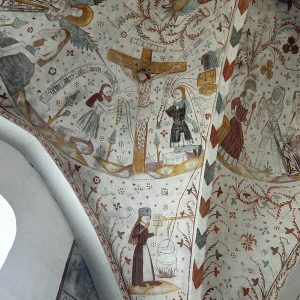 Figure 6. The Good and Evil Prayer, Keldby Church, Denmark, 2025. Photograph by the author.
The focus of the two figures was further emphasized by the Elmelunde Master by painted lines that follow their prayers and thoughts. These focal lines are key to this scene and get to the heart of where our attention should be. Directed through the sacred beads in his hands, the five lines emerging from the mouth of the poor man like prayers go directly toward Jesus, terminating in the five wounds from the cross. This is a reversal of the stigmata of St. Francis, who was known as Poverello, or “little poor man.”[8] Instead of the scars on the hands, feet, and side that the popular saint received from Jesus, the poor man’s words travel in the opposite direction and are literally affixed to the symbols of Christ’s divine sacrifice. In contrast, the rich man’s focal lines trace to his wealth and possessions: an elegant manor, fine linens, a horse, a filled chest, and a barrel possibly filled with expensive drink. This is a man of vanity, not faith.[9] Like the rich young man in Matthew 19, his focus is on his “great possessions” and not Jesus, even though he is in His presence. In Keldby, there is an additional line running down the pier to a young woman with long hair tending to a warm pot. The temptations here are clear, as are the allusions to another young man who once sold his birthright for a pot of porridge.[10] Instead of lines of devotion, these are lines of distraction. No devil necessary.
In all, I was grateful that my curiosity brought me to the small, painted churches of Møn. I visited and revisited the frescoes as often as I could and took far too many photographs of the Elmelunde master’s work (my youngest son jokes that I have more pictures of small Danish churches than of him – he’s wrong, of course, but I do have a lot). Of all that I was taught by the painted visual sermons, it was the repeated scene of the Good and Evil Prayer that impacted me the most. It has made me reassess the directionality of my focus. Despite my best intentions, I probably end up on Titivillus’s list more often than I should. I have, moreover, taken a ride or two on the bumpy wheel of life. And yet, I have also tried to keep my lines of focus, like that of the poor man, directed toward what matters most. I may not hold a rosary when I appeal to God, but my prayers and thoughts can be piloted toward the sacrifice of the Savior, and not to whatever my versions of fine linens or pots of porridge may be.
References
[1] Other examples of the work of Elmelunde Master and his workshop appear in the Danish churches of Nørre Alslev, Åstrup, and Kettinge.
[2] Birgit Als Hansen, W. Starp, L.V. Pistolekors, Die Kirchen Auf Møn (Stege: Møns Bogtrykkeri, 1988), 3. It is important to note that there are hundreds of surviving examples of kalkmalerier across Denmark. These discoveries are not unique to Møn or Denmark. See Michael Camille, Gothic Art: Glorious Visions (New York: Harry N. Abrams, 1996), 55-56.
[3] See Albert C. Labriola and John W. Smeltz, The Bible of the Poor [Biblia Pauperum] (Pittsburgh: Duquesne University Press, 1990), 1, 8-10.
[4] Bent Schiermer Andersen, Fanefjord Church, Jesper Bernøe, trans. (Møn: Sangill Grafisk/Næstved, 2020), 17. The figure might also be the demon Belias, who was the patron demon of gossip.
[5] Titivillus is probably best known for his success in harassing monks and scribes, lulling them into making errors in their work.
[6] I would like to thank Dr. Elliott Wise and Dr. Charlotte Stanford for their assistance with these medieval Latin texts
[7] See Luke 18:10-14.
[8] I would like to thank Dr. Wise for this important insight.
[9] See Psalm 144: 4.
[10] See Genesis chapter 25.