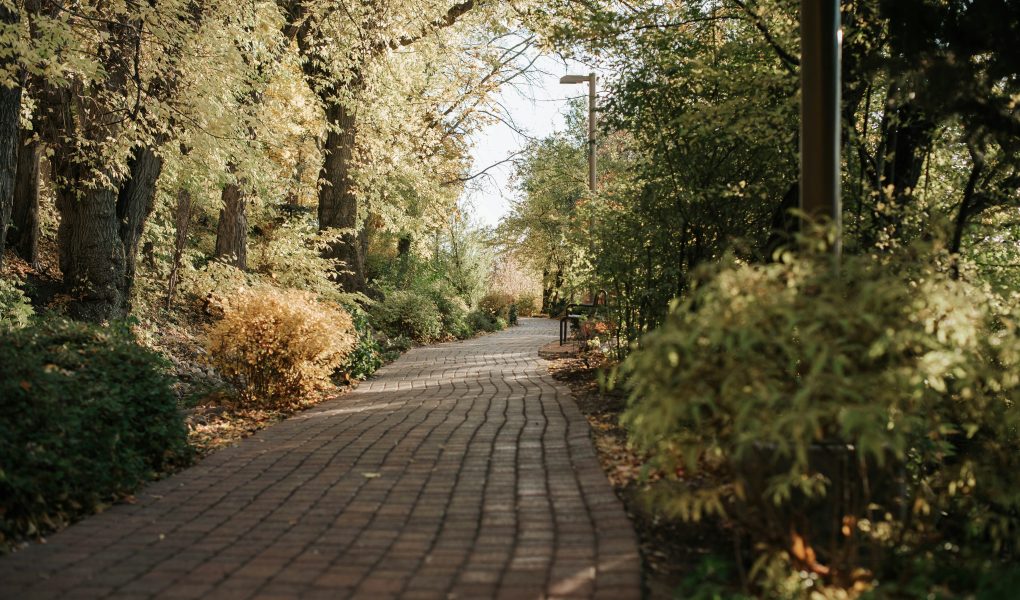
Provo Walks is a set of unique self-guided walking tours that present a new way to engage with Provo’s community and culture. Recently featured as a “Beacon of Light” on the BYU College of Humanities website, the project, which was sponsored by the BYU Humanities Center, constitutes a form of public scholarship intended to benefit the Provo community and foster a sense of belonging for both residents and visitors.
Professor Rex Nielson—one of the project’s original creators and Director of the BYU Humanities Center—says that Provo Walks was designed as a public outreach project. After a memorable conversation with the director of the Provo City Library, Professor Nielson began to wonder what the College of Humanities could offer to encourage interactive engagement with the local community. These thoughts led to the idea of a series of self-guided walking tours throughout Provo. The walks were designed so that faculty from BYU could share their individual expertise in a way that directly benefited and engaged the public.
Professor Nielson explains that Provo Walks has two primary purposes. The first is to encourage place-making, based on the concept that a place is made through learning about its people and its history [1]. In that sense, learning about Provo through these walking tours makes the city feel more like a place, a community where shared stories unite residents. The second purpose is to encourage wayfinding, a geographical understanding of how different points in a city connect to one another. Provo Walks encourages the public to explore parts of the city they might not be familiar with. Professor Nielson says that the process of developing the walks has been “very organic,” and that he’s been open to “anyone who comes to me and has an interesting idea.”
Right now, there are six self-guided walks of Provo on the BYU Walks app. Each of the walks gives a tour of a different aspect of Provo’s history, covering ground everywhere from Provo’s downtown murals, the origins of BYU, and the Topaz Japanese Internment Camp. Several walks have been developed through student courses, while others have been created independently by faculty. Professor Nielson and BYU student Gabbie Schwartz designed the BYU Origins walk with the goal of providing people with “a richer, deeper, broader understanding of campus and how we came to exist.”
About six more walks are also in development. Professor Marlene Hansen Esplin, who teaches in the Comparative Arts and Letters Department, is currently revising the Provo Walk titled “Celebrating the Women of BYU.” The idea for this walk came from a study abroad in England that Professor Esplin co-directed in Spring 2024 through the Global Women’s Studies program. After taking several tours that focused on women’s history in cities like London and Manchester, students in the program asked why BYU didn’t offer something similar. This idea became a student proposal, which developed into a class that Professor Esplin co-taught with Cristie Cowles Charles in Winter 2025. “It’s been a faculty-mentored, student-led project,” says Professor Esplin. The walk is tied specifically to the 150th anniversary of BYU and aims to celebrate the women who have played pivotal roles in its history.
Like the other walks of Provo, “Celebrating the Women of BYU” is tied to geographical sites, and those following the app are encouraged to visit each of these campus sites in person. The walk is meant to take no more than two hours, but Professor Esplin explains that it’s been difficult to condense the information into such a short time frame. As she described it, “We started out not having much information, and now we have the blessing of way too much information. We’re trying to hone the walk so that it’s engaging, in addition to being replete.” To facilitate further learning and streamline the tour, the walk includes collapsible bios about several of the women in BYU’s history. “We’ve tried to make it very engaging. Every name in bold represents a life story, so we’ve had to do a lot of fact checking to make sure that we’re accurately representing people’s lives.”
The walk has fostered kinship between many of the students and the women they’ve studied, facilitating belonging both for those whose stories it shares and those who’ve worked in its development. Professor Esplin attests that “it’s helped [students] feel connected to women on campus, even some students who may have had questions about whether they belong at BYU. They can say, ‘hey, look at these women who overcame hard things and institutional obstacles to support each other and students at BYU.’” Furthermore, the walk has given students something tangible and community-based to work toward. Professor Esplin points out, “Students can say, ‘I helped create the first campus walking tour celebrating women of BYU.’”
Though BYU students are among the most directly involved in these projects, Provo Walks is for more than just those who attend the university. Professor Nielson clarifies that the walks are also catered toward the general public. Inclusions such as the Provo Bike Walk and the Provo River Delta are meant to appeal to any and all residents, and several of the walks in development are not specific to BYU’s campus. As stated by one student who helped design the Provo River Delta walk, “The main goal is to deepen understanding. To have an understanding for something is to love something. We’re helping people find a greater love for their community, to appreciate where they live and where they’re visiting.”
Whether they enjoy a sunset stroll by the Provo River or the striking murals of downtown, Provo Walks has provided the public with a way to discover this “greater love for their community.” As more walks are added to the current suite, new stones and new stories will be uncovered, and new people will learn about them. In a city with as much as going on as Provo, there will always be something more to learn.