This essay was written by Brendan Murphy, a BYU Humanities Center student fellow.
In English classrooms (at least those in which I often find myself), it’s common to hear complaints or praise for various literary genres. The novel is definitely winning the popularity contest, but lyric poetry also seems to be firmly in the race, along with genre fiction and multimedia forms like the graphic novel. I often find myself somewhat put-off by such discussions, perhaps because some of my favorite works seem to cross genre boundaries. (I’m also sad for nonfiction and memoir, which have rarely made their way into my English syllabi, let alone the popularity contest.) Despite my personal distaste for these conversations, they, along with a class I am taking on the development of the British novel, have gotten me thinking about genre divisions, and more especially on the ways in which genres transform. With this summer’s release of Christopher Nolan’s film adaptation of The Odyssey, public attention has re-focused on a genre previously lost to many readers today: the epic. I’d like to use this cultural moment to reflect on the ways the epic genre has been and continues to be novelized—to borrow a concept from Mikhail Bakhtin—establishing itself as a cultural and political force.
In his 1941 essay “Epic and Novel: Toward a Methodology for the Study of the Novel,” Bakhtin argues that the novel’s power lies in its unformed state, its novelty or newness. “We,” Bakhtin asserts, “cannot foresee all its plastic possibilities.” A living genre is novel, with the capacity to change. For Bakhtin, the epic, on the other hand, is a canonically fixed and, in a sense, dead genre. He writes its obituary in no uncertain language:
We encounter the epic as a genre that has not only long since completed its development, but one that is already antiquated. With certain reservations we can say the same for the other major genres, even for tragedy. The life they have in history, the life with which we are familiar, is the life they have lived as already completed genres, with a hardened and no longer flexible skeleton. Each of them has developed its own canon that operates in literature as an authentic historical force. [1]
We find the novel’s vitality, Bakhtin suggests, in the sense that it might be otherwise than it currently is. He is not saying that the epic does not influence literary fiction or the contemporary cultural milieu; rather, it exerts “an authentic historical force” (italics added). Bakhtin claims what seems prima facie correct: people are not writing (or singing, telling, or chanting) epics like they used to. However, the past century alone has seen the publication of important verse-novels which fall at least into the extended family of epic poetry. Take, for example, Ezra Pound’s well known The Cantos (1925) and Linnea Axelsson’s Ædnan, a Swedish-Sami verse-novel explicitly described as an epic (2018).
Another relatively recent epic, Kalevala (1835, 1849), Elias Lönnrot’s Finnish national epic, is broadly recognized as the most significant national epic of the 19th century. The second edition consists of 50 poems, many of which Lönnrot compiled and edited after a long ethnographic oral poetry collection project in areas of Finland and modern-day Russia, then part of the Finnish region of Karelia. The last poem in the 1849 edition of the Kalevala, Runo 50, tells the story of Marjatta, a young Finnish woman, who gives miraculous birth to a son. Väinämöinen, the Kalevala’s hero, leaves Finland when Marjatta’s son is born, but he promises to someday return to bring music and joy back to Finland.

Literary scholars often read Runo 50 as a figuration of Finland’s pre-Christian past and the subsequent Christianization of Finland beginning in the 11th century. Marjatta’s miraculous son is an obvious symbol of Christ, but so is the hero Väinämöinen, whose return will usher in a new age of peace and prosperity in Finland, a syncretic fulfillment of the Christian allegory. Runo 50 provides an eschatological Finno-nationalist structure to Kalevala, particularly through its Messianic depiction of the hero Väinämöinen and Lönnrot’s Fennoman (19th century Finno-nationalist) cultural and conceptual milieux.
In Runo 50, Väinämöinen receives sustained attention. We read a similar condemnation from Marjatta about Väinämöinen’s sins (from his pre-Christian past and epic exploits) and exile but then hear Väinämöinen sing about his departure and future return. He sings, “Again I will be needed / To be beheld, to be longed for / A new Sampo to receive / A new song to be given / As the new moon driver / As the new day’s preserver / When no moon, sun / Not without joy” (493–99, 394, my own translation). [2] The Sampo is a mythical artifact, one which provides hoards of abundance, including gold and food. Väinämöinen will return, he sings, when he and the Sampo he possesses will again be needed. Here, we find an eschatological structure in which time is split into a pre-Christian Finland (the story of Runo’s 1-49), the Christianization of Finland (Runo 50), and a return of Väinämöinen and Finnish abundance, reminiscent of and likely allegorical to the Second Coming of Jesus Christ. By inserting the prophecy of Väinämöinen’s return, Lönnrot draws the reader’s attention to the Messianic role of the text itself. Kalevala is aware of itself and its place in a national Romantic movement, drawing the reader at least pre-reflectively into a constructed, novelized epic temporal and cultural structure.
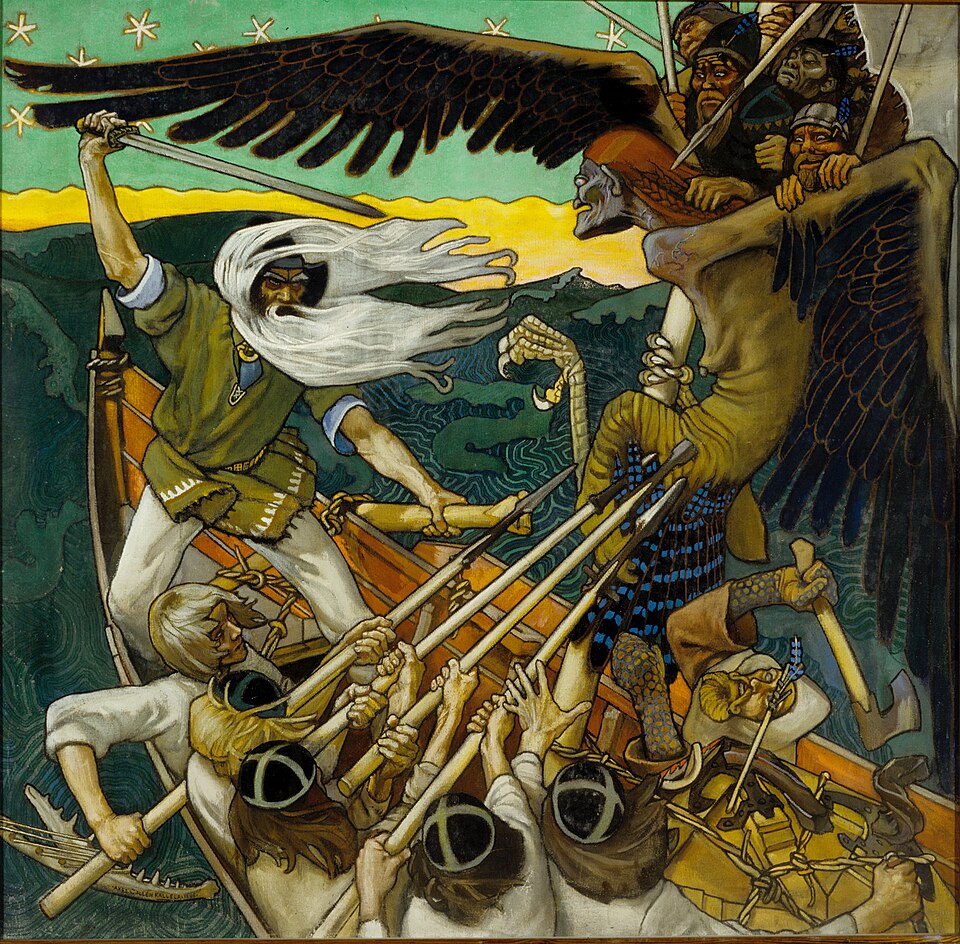
While this reading is certainly speculative, it provides a compelling argument for the structural impact of Kalevala. The structure is eschatological and reflective of the cultural moment, splitting time into a pre-Christian, Christian syncretic, and post-Christian syncretic framework resulting in the Messianic liberation of Finnish culture. This framework has aged remarkably well, providing a historical hermeneutic for the political development of Finland in the 19th and 20th centuries. With the establishment of the Russian Grand Duchy of Finland and later independence in 1917, this structure became a political eschatology as much as a cultural one. Lönnrot’s prescience and Väinämöinen’s prophecy allows Kalevala to take on the role of cultural and political Sampo. The reclaiming of Finnish culture and political independence is the culmination of a poetic structuring of history through Kalevala itself, at once disrupting the established epic canon while inserting an epic temporal structure into the political and social realities of the present.
Kalevala speaks to the establishment of the contemporary Finnish state, a state established in 1917, but which only began to be conceived as a possible reality during the time of Lönnrot’s collection and the epic’s publication. The Kalevala was the chief literary accomplishment of the fledgling Finnish Romantic nationalist movement, serving a vital role in a distinctly modern political atmosphere. It remains an active part of the Finnish national imagination and has been adapted or drawn on for inspiration by figures inside and outside of Finland, including notably by J.R.R. Tolkien in Lord of the Rings.
For his part, Bakhtin does not leave the epic for dead. Instead, he sees such canonized dramas following a process of novelization, a resurrection of sorts, one which we can see in the development of Kalevala. For Bakhtin, epics and other canonized genres
become more free and flexible, their language renews itself by incorporating extraliterary heteroglossia and the “novelistic” layers of literary language, they become dialogized, permeated with laughter, irony, humor, elements of self-parody and finally— this is the most important thing— the novel inserts into these other genres an indeterminacy, a certain semantic openendedness, a living contact with unfinished, still evolving contemporary reality (the openended present). (7, italics added) [1]
This novelization process appears clear when we examine the Kalevala, but also across the board, especially as we consider the recent commercial success of Nolan’s The genre’s development provides us with a dynamic way of thinking about the possibilities of identity, prophecy, and creativity in literary narratives. The epics of the traditional canon have the capacity, at least in my own experience, to have similar effects. What Lönnrot demonstrates is a novelization of the epic, a translation of its tropes through space, time, and thematic elements.
Like Kalevala in the 19th century, Nolan’s The Odyssey responds to our national and international moment, a time of unease, war, and broken bonds of trust between nations and identity groups. While I enjoyed the film, I do not see it exercising the same level of influence as Kalevala has. Nonetheless, I welcome its attempt to novelize and cherish one of the most impactful works of the western and epic traditions, following the path of Kalevala and many epics to have come before.
References
[1] Bakhtin, Mikhail M. Dialogic Imagination: Four Essays. Edited by Michael Holquist, University of Texas Press, 1981.
[2] Lönnrot, Elias. “Viisikymmenes Runo,” text from 1849 Kalevala, Elias Lönnrotin Kalevalan Toinen Painos, edited by Väinö Kaukonen, Helsingin Liikekirjapaino OY, Suomalaisen Kirjallisuuden Seura, 1956.