This post was written by Cherice Montgomery, a BYU Humanities Center faculty fellow.
Come, Follow Me
The scriptures are replete with invitations from the Savior to “…come, follow me” (Luke 18:22). I thought I knew what that meant—until I attended the Genesis Writing Retreat in Oxford, England. While there, I had the privilege of lingering in the places and spaces where famous authors like C.S. Lewis and J.R.R. Tolkien spent much of their lives. As is true of most tourists, at first, many in our group anxiously tried to maximize their limited time in Oxford by attempting to see as much as they could as quickly as possible. The result was that even the most comprehensive walking tours left only fleeting impressions of a monument or a plaque here, a funny anecdote there. The true significance of Oxford only became apparent after we had made repeated passes through different parts of the city for different purposes. Enduring meaning came through micro-moments of musing and meandering. The more time I spent walking where famous authors walked and doing things they had done, the more insights I gained about their lives, their work, and their discipleship.
The Word Made Flesh
Similarly, when the Savior encourages us to “follow me, and do the things which ye have seen me do” (2 Nephi 31:12), He is not extending a casual invitation for a quick, touristy visit. Instead, He is offering to accompany us on the long journey of becoming. As “the Word…made flesh” (John 1:14), He knows that although reading about His life can help us come to know Him, we will never be able to see things from His perspective until we walk where He walked, see what He saw, and do what He did. As we do so, we will develop habits that eventually lead us to see as He sees and know as He knows (see Doctrine & Covenants 76:12, 18, 20, & 94).
Although I had always interpreted the extended nature of this transformative journey as a test of worthiness, I now suspect that it is less of a destination to be reached and more of a metaphorical wandering in the wilderness that shapes who we become. The scriptures make it clear that such transformation does not occur immediately. Even many of those who spent time in the physical presence of the Savior and witnessed His miracles were unwilling to accept the invitation to follow Him, much less to persevere long enough to actually be transformed (see Doctrine & Covenants 138:26). Yet even Jesus, who was “the Spirit of truth, which came and dwelt in the flesh, and dwelt among us….received not of the fulness at first, but continued from grace to grace, until he received a fulness” (Doctrine & Covenants 93:11, 13). So, it is worth remembering that even when we seem to be traveling the same road repeatedly or for an extended period of time, every step deepens our discovery, adding depth and dimension to our discipleship.
The Enlightening Power of Play, Perception, and Physical Experience
So, from whence does transformation come? There is a big difference between intellectual knowledge (knowing), embodied experience (doing), and spiritual integration (becoming). Although I had studied the works and biographies of many of the famous authors who were educated at Oxford (knowing), it wasn’t until I participated in many of the activities they did (doing) that I came to understand how much their work was largely the result of simple included daily writing fed by thoughtful observation, long walks, museum visits, shared meals at local pubs, and frequent talks.
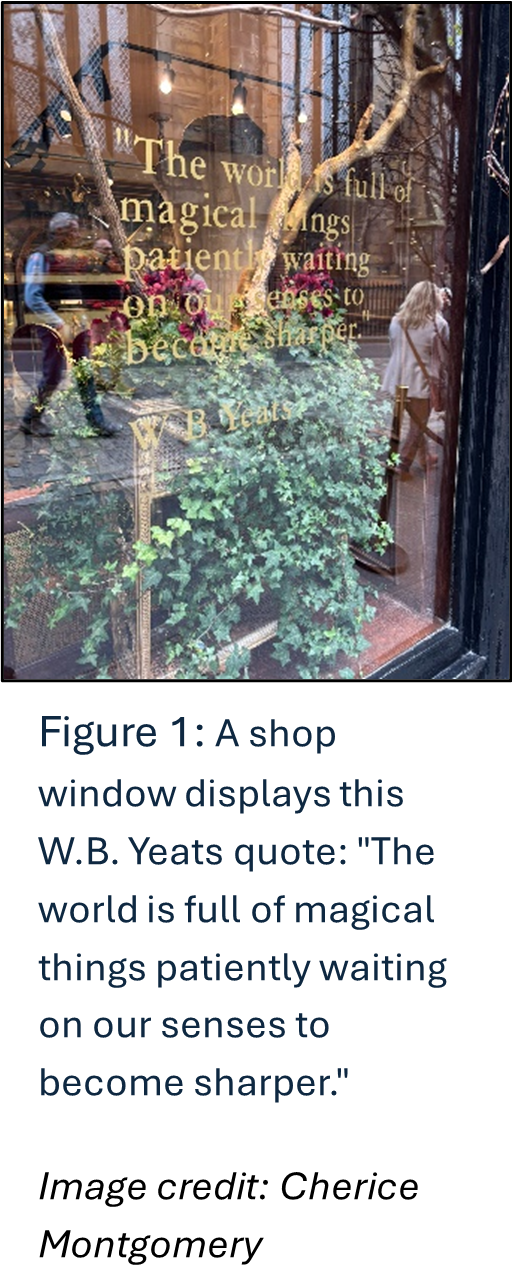
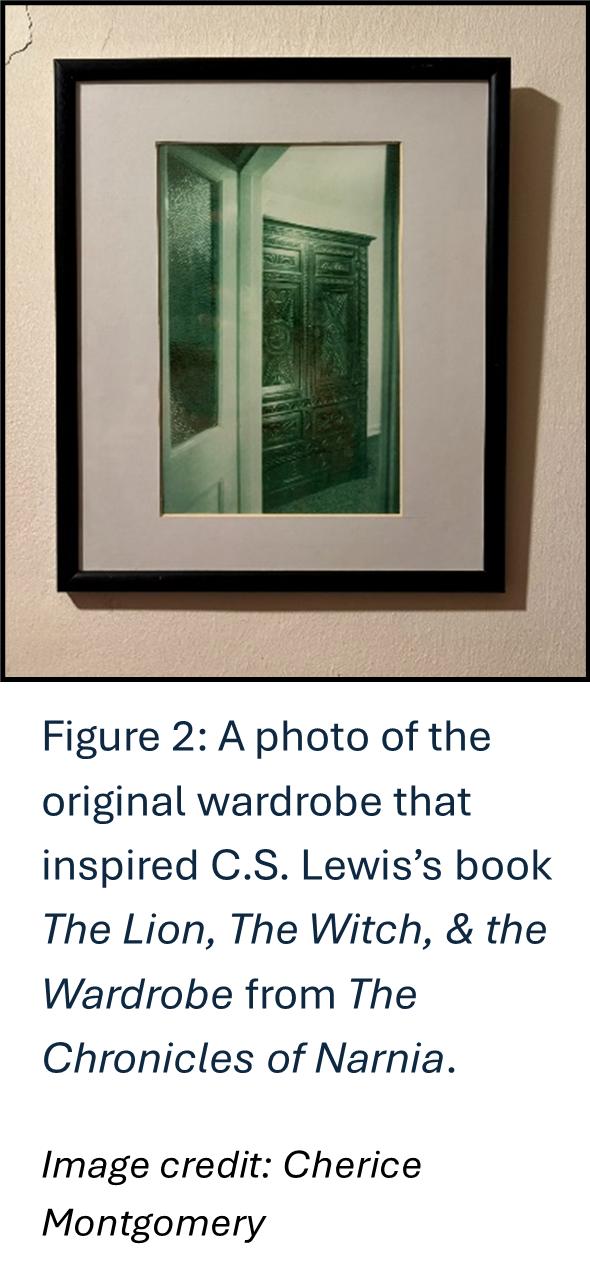
These Oxford writers were enthusiastic meanderers and keen perceivers attuned to even the most inconsequential aspects of their surroundings (Figure 1). Their patterns of careful observation, combined with wild imagination, enabled them to perceive possibility where others only saw pedestrian routine. There was no separation between the mundane elements of their lives and their work. In fact, their work grew from the seeds of those ordinary details. Thus, wardrobes became gateways to enchanted kingdoms (Figure 2); trees and statues morphed into fantastical creatures (Figures 3-7); and college gardens transformed into magical wonderlands (Figures 8-9).



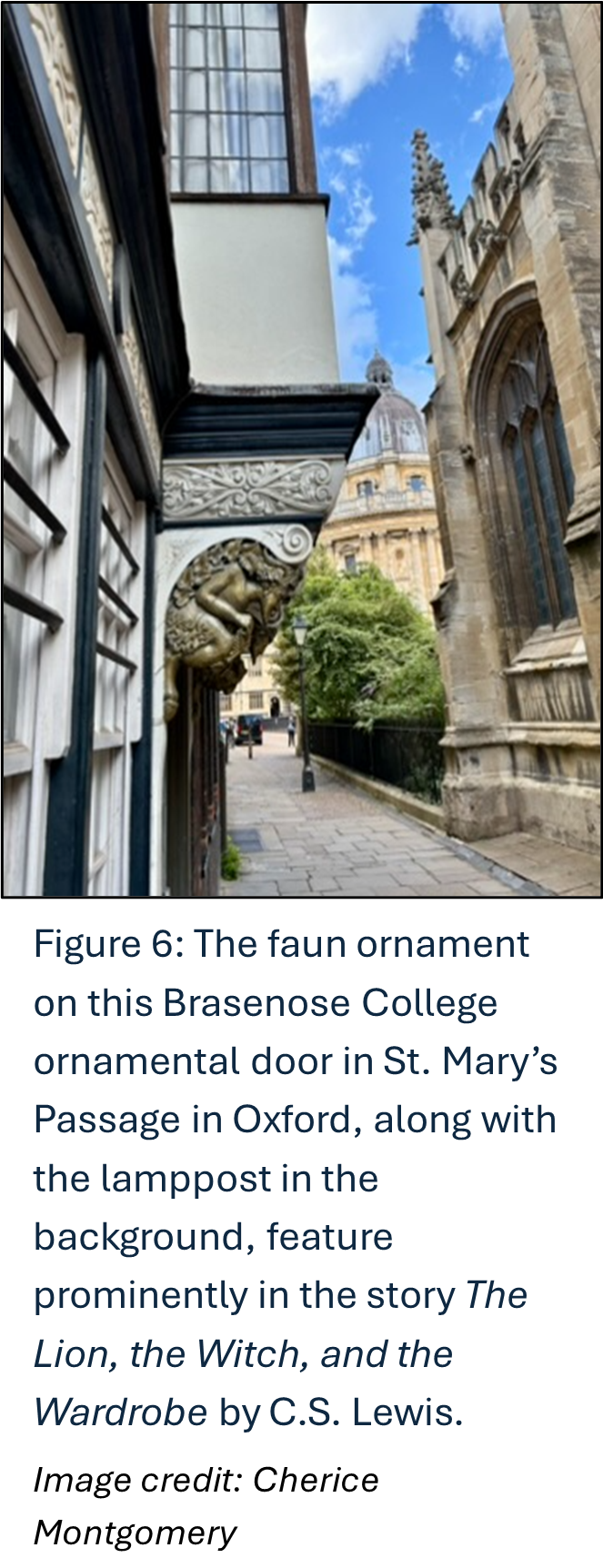
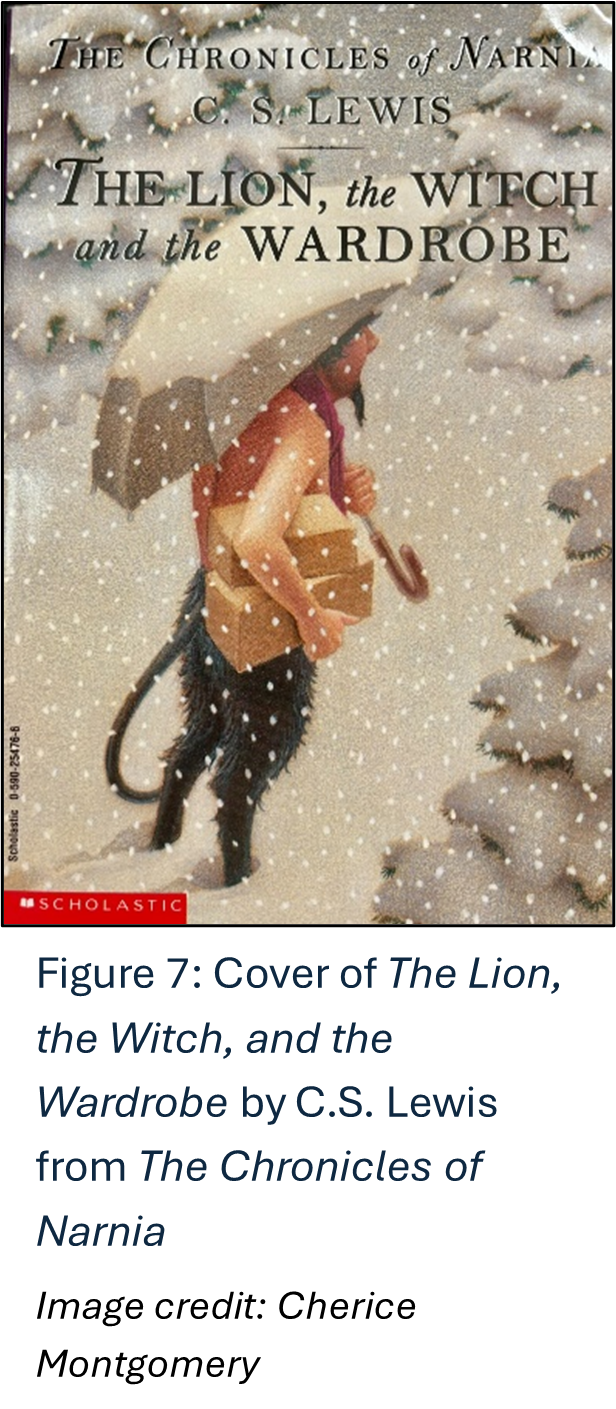
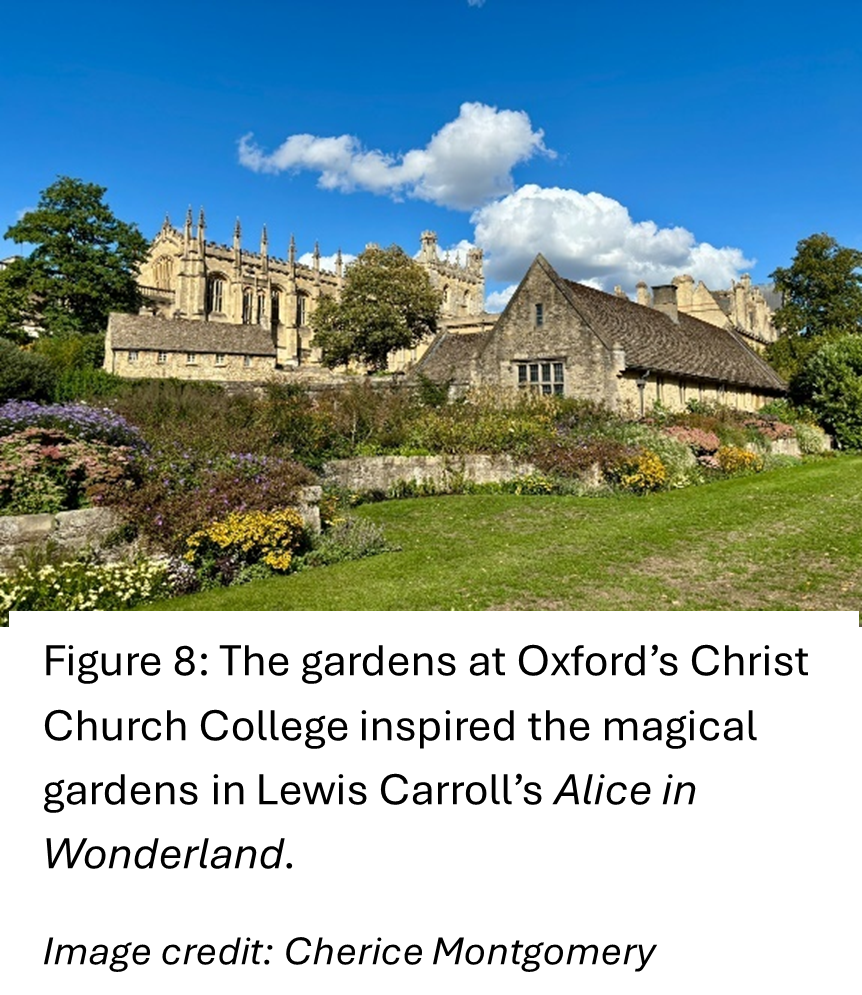
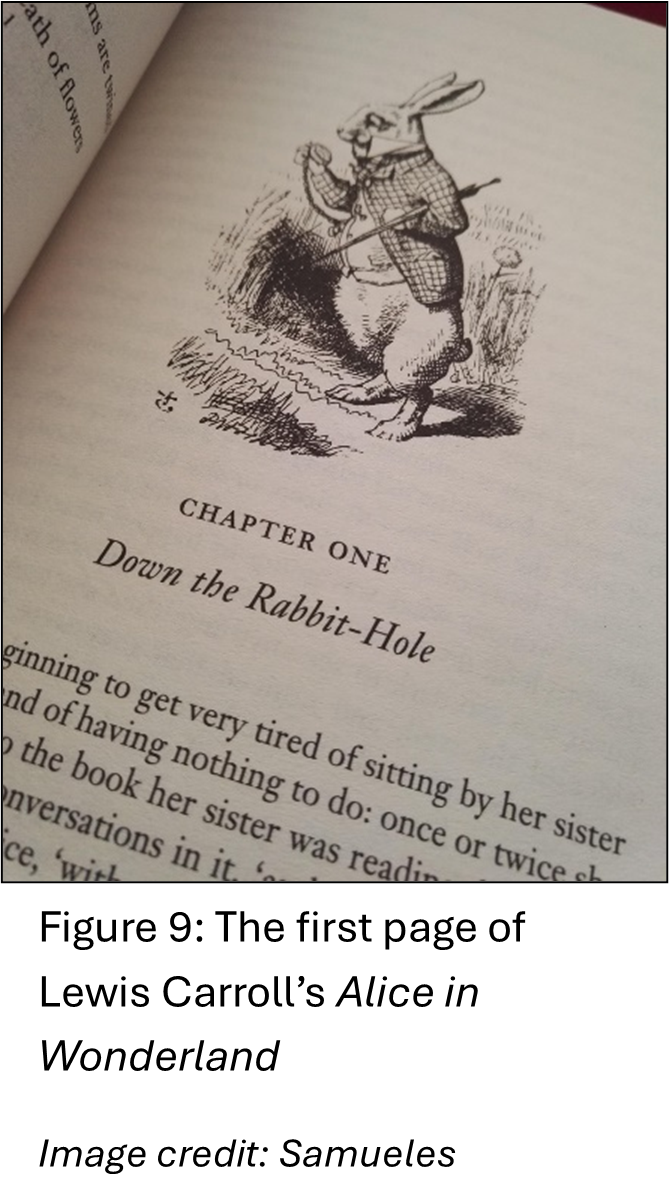
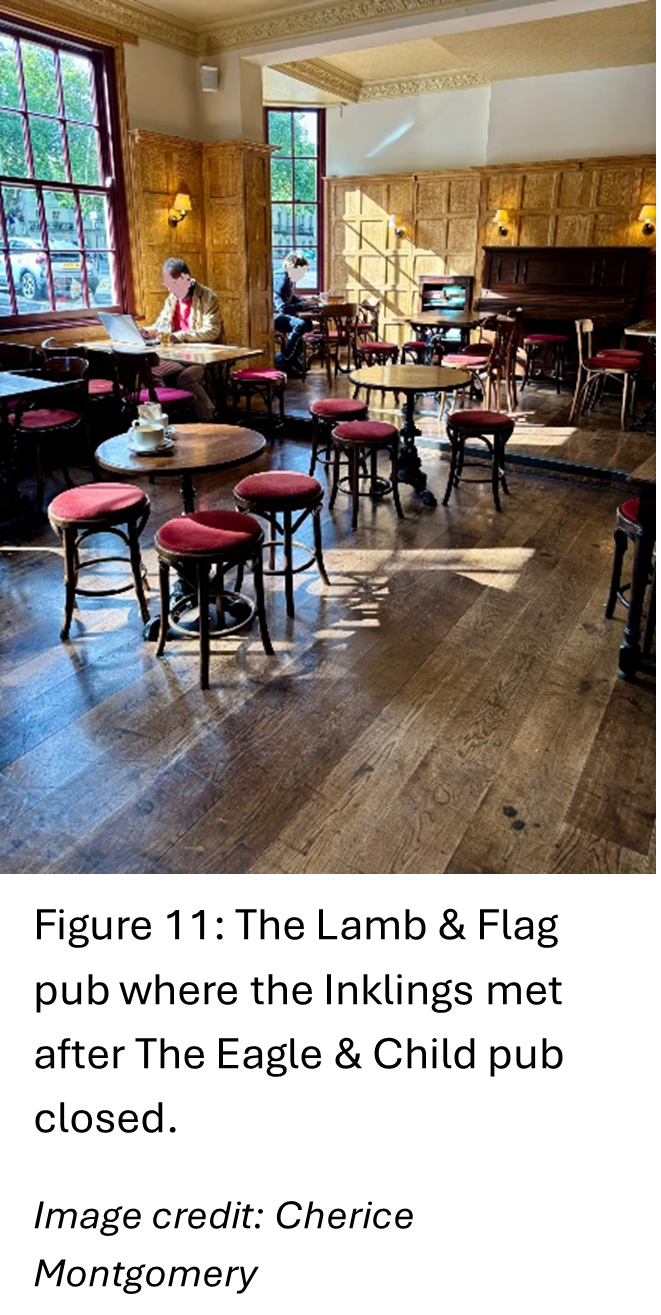
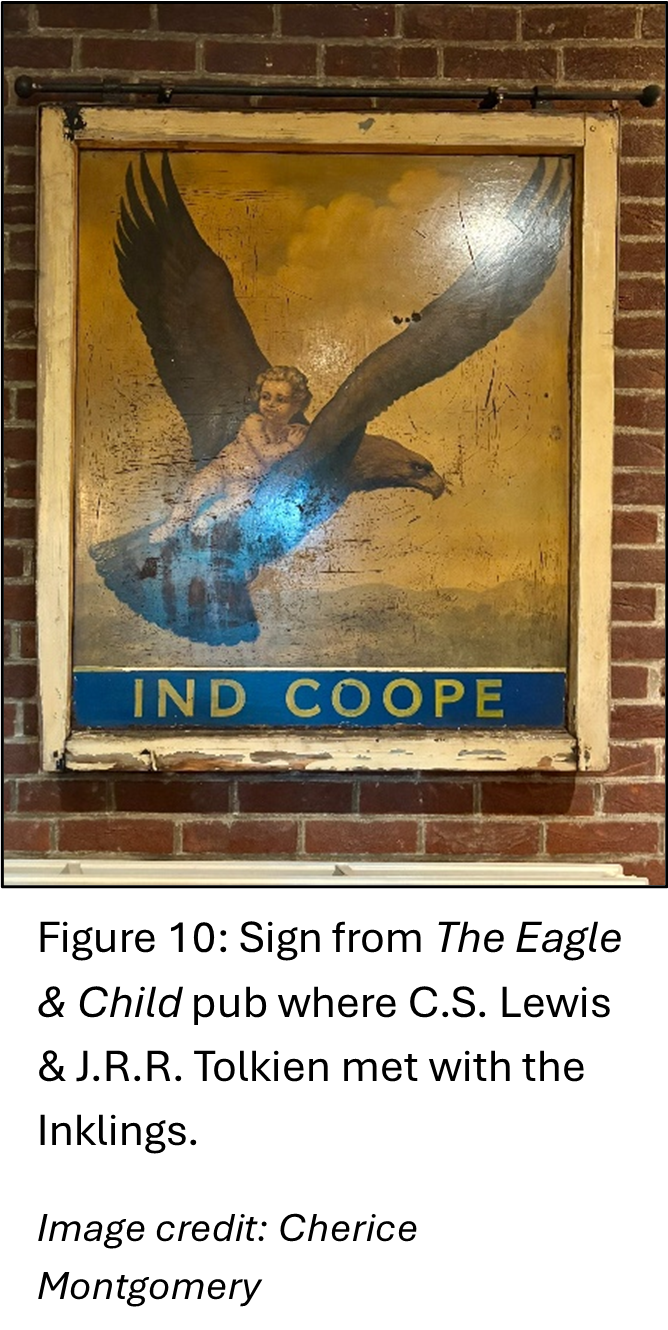
I was also struck by the extent to which many of their most well-known works were produced as a seeming by-product of their leisure activities. For instance, many of the ideas for C.S. Lewis & J.R.R. Tolkien’s greatest fantasy novels were sparked and subsequently
developed during their weekly gatherings at local pubs such as The Eagle & Child and The Lamb & Flag (Figures 10 & 11). Many elements of C.S. Lewis’s The Chronicles of Narnia came from playing in his home.
Lewis Carroll would often tell stories to Alice Liddell and her sisters while boating up the River Thames. He agreed to write down the story that eventually became Alice in Wonderland because Alice loved it so much (Collingwood, 1862). Many elements that appear in his stories were inspired by frequent visits to the Museum of Natural History and the Oxford Botanic Garden, as well as by activities such as picnics and tea.
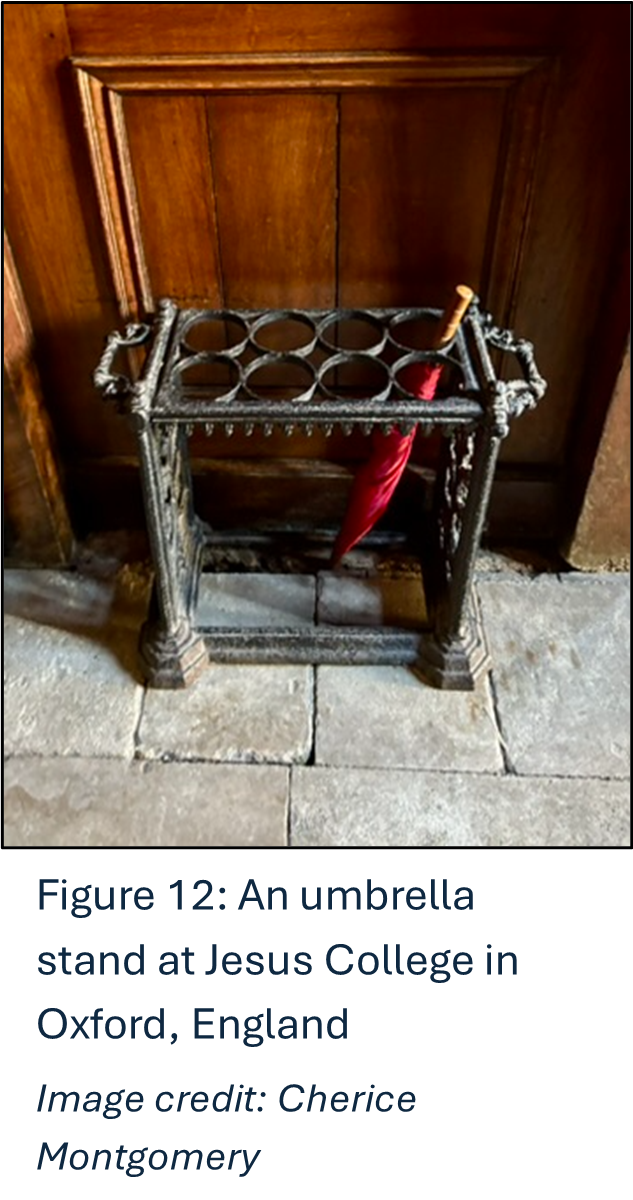
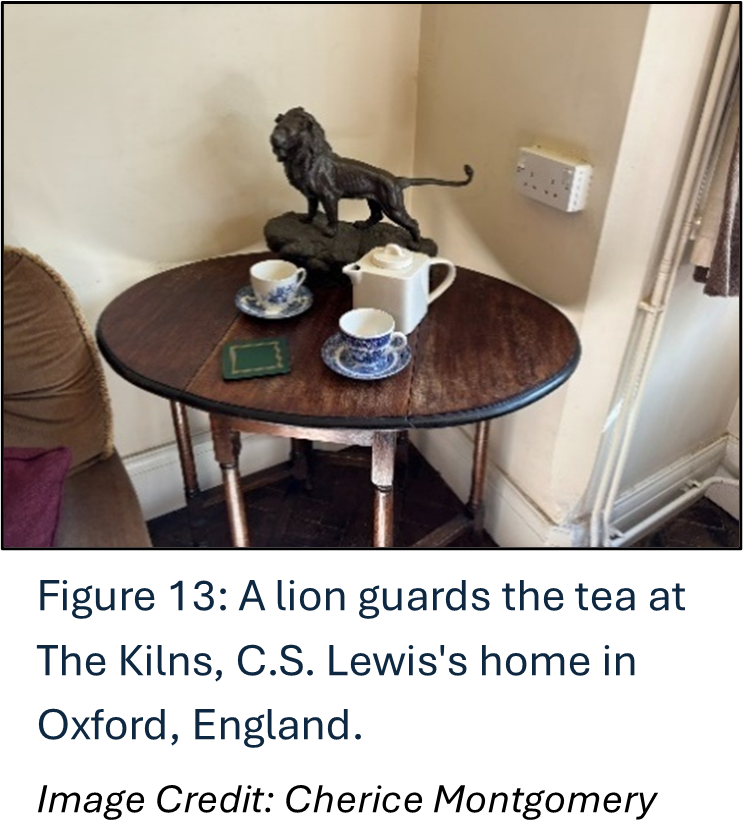
In literature, afternoon tea is often portrayed as a quaint social activity that connotes propriety and sophistication. The UK’s affinity for it only makes sense after one has personally experienced the nation’s perpetual rain (Figure 12), pervasive dampness, and the chilly discomfort of stone buildings that pre-date the 16th century. Far more than just a charming cultural custom, drinking tea is a logical response to the daily realities of life there (Figures 13-14). During the Mad Hatter’s tea party in Alice’s Adventures in Wonderland (Figure 15), Lewis Carroll satirizes this and other well-established cultural customs (e.g., personal space, courtesy, indirect communication, and punctuality) to demonstrate the irrationality of relying on social convention to evaluate the quality of one’s life or the degree of one’s sanity.


Prioritizing People: The Transformative Power of Friendship
Just as Alice’s adventures expanded her perspective and deepened her understanding of others, walking as Christ walked means that we must spend time with people whose beliefs, experiences, and thoughts differ from our own. As we do so, we too can acquire the deeper, more complete understanding that accompanies a Christ-like perspective (“…they see as they are seen, and know as they are known, having received of his fulness and of his grace”) (Doctrine & Covenants 76:94).
C.S. Lewis and J.R.R. Tolkien are good examples of this principle. Neither could have “…filled the measure of [their] creation…” (Doctrine & Covenants 88:19-25), gifting the world powerful stories of good and evil, without one another. C.S. Lewis needed J.R.R. Tolkien’s unconditional friendship and persistent encouragement to make the journey from being a staunch atheist to becoming one of the greatest defenders of Christianity in the 20th century. In turn, Tolkien needed the intellectual challenge and frequent praise that Lewis provided to persevere through the 17 years it took him to create the heights and depths of Middle-Earth. In both cases, their genius was ignited by proximity and shaped by the community that emerged from their consistent participation in activities and relationships that fed their souls. In like fashion, as we spend time with the Savior, we will find ourselves inside the covenant community of the Savior’s inner ring.
Finding Joy in the Journey
However, I suspect many of us have spent more than a fair amount of time worrying about whether we are good enough to “make it into” the “inner ring” of the celestial kingdom. During doubtful, shame-filled moments of uncertainty when living the gospel seems too hard and promised blessings seem too far away, we can take great comfort in the lyrics from I Am A Child of God: “His promises are sure—celestial glory shall be mine if I can but endure” (Randall, 1978). My time in Oxford taught me that perhaps enduring has less to do with slogging along (although there may be some of that) and more to do with habituating ourselves to look closely, ponder persistently, and open our hearts widely to the joys scattered throughout the journey. We do not have to have a finished product in mind or even know all that much about what we are trying to do before we attempt the journey. Because of Jesus Christ, we can always choose to try something different or to become someone new. The key is to focus on “journey before destination” (Sanderson, 2017, p. 378), to keep trying when things fall apart, waiting patiently and trusting God’s timing. As we show up, make a habit of noticing what inspires us, give ourselves to it, and share our imperfect efforts with others, the outcome will take care of itself: “If any man serve me, let him follow me; and where I am, there shall also my servant be: if any man serve me, him will my Father honour” (John 12:26).
Image Credits
Figure 9: First page of Alice in Wonderland: Samueles. (2017, Oct. 30). Pixabay. Retrieved Dec. 7, 2025 from https://pixabay.com/photos/alice-english-wonderland-rabbit-2902560/
Figure 15: The Mad Hatter’s Tea Party: Azzy_roth. (2014, Feb. 27). Pixabay. Retrieved Dec. 7, 2025 from https://pixabay.com/vectors/alice-in-wonderland-tea-party-276452/
All other images: Cherice Montgomery. (2025, September). Oxford, England, UK.
References
Carroll, L. (1865). Chapter VII: A mad tea-party. Alice’s Adventures in Wonderland (Lit2Go Edition). Retrieved January 10, 2026, from https://etc.usf.edu/lit2go/1/alices-adventures-in-wonderland/17/chapter-vii-a-mad-tea-party/
Collingwood, Stuart Dodgson. (1862, Jul. 4). The Life and Letters of Lewis Carroll: Chapter III. Wikisource.org. Retrieved from https://en.wikisource.org/wiki/The_Life_and_Letters_of_Lewis_Carroll/Chapter_III
Lewis, C.S. (1944). The inner ring. Memorial Lecture at King’s College, University of London. Retrieved from https://www.lewissociety.org/innerring/ Also available: https://noorsiddiqui.com/papers/TheInnerRing.pdf
Randall, N.W. (1978). I am a child of God. The Church of Jesus Christ of Latter-Day Saints (IRI). Retrieved Jan. 12, 2016 from https://www.churchofjesuschrist.org/media/music/songs/i-am-a-child-of-god-wolford?lang=eng
Sanderson, Brandon. (2017). Oathbringer: Book Three of the Stormlight Archive. NY: Tor Books.