Date/Time
Date(s) - 11/07/2025
3:00 pm - 5:00 pm
Location
EIZ Theater - JFSB B192
Category(ies)
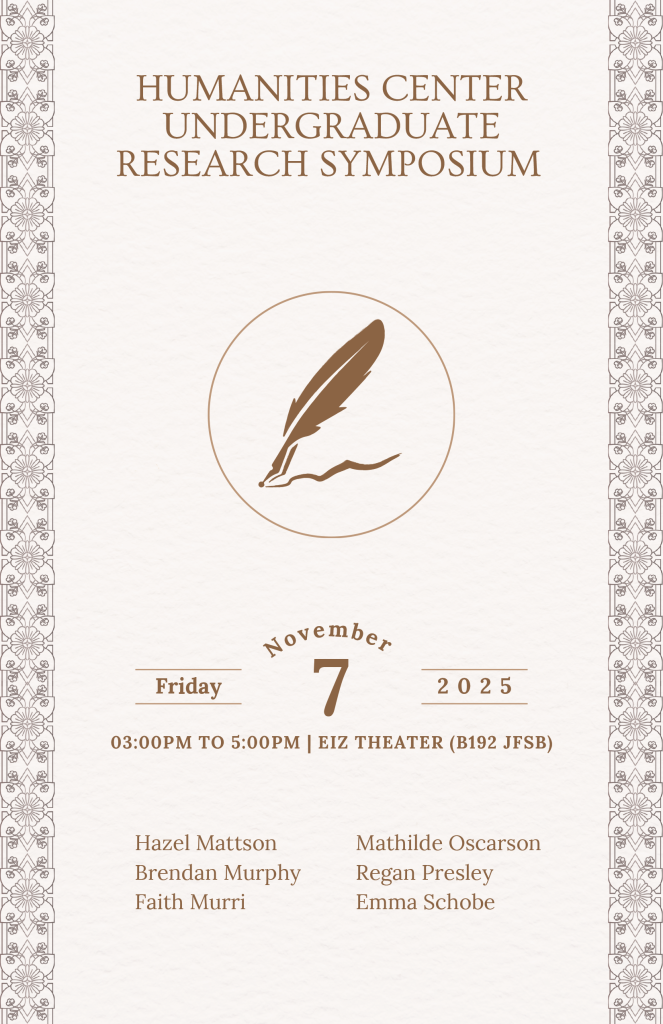
The Humanities Center will hold its annual Undergraduate Research Symposium on Friday, November 7 at 3:00 PM in the EIZ Theater (B192 JFSB). This symposium will highlight student research recently conducted as part of their Humanities Undergraduate Mentoring (HUM) Grant.
This year’s presenters include:
- Hazel Mattson (Linguistics) — Dialectical Variation in Albania
- Brendan Murphy (English & Philosophy) — Poetic Self-formation and the Victorian Preface
- Faith Murri (English) — “Sensation Rubbish’ Redeemed: Etta W. Pierce’s Gothic Critique of Patriarchal Constraint in the Gilded Age
- Mathilde Oscarson (Art History & French) — Centering and De-Centering Paris: A Cultural History of the Pont Neuf
- Regan Presley (Art History) — The Divine Union: Understanding the Syncretism of Isis and Hathor in Ancient Egyptian Art
- Emma Shobe (English) — From Pasternak to the Present: Feminist Critical Theory and the Western Reframing of Doctor Zhivago
We hope you’ll join us. Refreshments will be served afterwards.
Hazel Lindsay
Within the Albanian language, there are two main dialects: Tosk, which is spoken mainly in southern Albania, and Gheg, which is spoken mainly in northern Albania and Kosovo. Until recently, both were used in formal and informal contexts (i.e., in official documents, in translated works like the Bible, in novels and articles, in speaking, etc.) In 1972 the language was standardized, and Gjuha Leterare (‘the literary language’) was born. Today, this is the dialect taught in schools and used in official communication, but dialects of both Tosk and Gheg are still widely spoken. In my study, I went to Albania and Kosovo to interview speakers of both dialects, focusing on their attitudes towards the different varieties of Albanian. My research showed that rather than judging Gheg, Tosk, and Gjuha Leterare as three distinct and well-defined entities, speakers held positive or negative views towards independent aspects of each. A pattern emerged; aspects of the language—no matter the dialect in question–that were viewed by the speakers as being their own (things that were more “Albanian”) were viewed positively, whereas aspects of the language that were seen by the speakers as being forced upon them or chosen by someone else (less “Albanian”) were viewed negatively. This conclusion opens the possibility for further research on the connection between perceived autonomy in choosing how a language is standardized and attitudes towards the standardization itself.
Brendan Murphy
Beginning with the watershed Lyrical Ballads’ 1798 preface, the development of prefatory, often autobiographical poetic criticism accelerated rapidly through the 19th century. The paratextual genre developed most significantly through 19th century poetry and prose prefaces. In this paper, I will analyze prefaces by Elizabeth Barrett Browning and Matthew Arnold in conjunction with the work of the Scottish literary critic David Masson. I first lay out a dispute between Masson and Arnold ranging across their prefaces regarding the nature of poetic identity, demonstrating the role of the preface as a place for poets’ philosophical reflections on their own poetry and their poetic and historical contexts. Matthew Arnold begins this conflict in his well-known 1853 preface to his collected Poems, addressing Masson directly. While some work was done in the latter half of the 20th century on these references, there has been little work done on Masson’s poetic theory ranging across his works. I attempt to begin addressing this need in the scholarship. In the second section, I argue that Victorian authors’ prefaces to poetic collections provide a setting of philosophical reflection and criticism on the concept of the poetic self through their applications of autobiography, utilizing Barrett Browning’s preface to her 1844 collection Poems Before Congress. In this section, I apply Masson’s framework for poetic imagination to a comparative analysis of Barrett Browning and Arnold’s prefaces. I conclude with a reflection on the prefaces from a philosophical-critical perspective, arguing with Masson that the poetic spirit in prose (an element of many, if not all, poetic prefaces, I suggest) plays an integral role in the creation of a poet’s concept of herself and her poetry.
Faith Murri
This presentation offers a critical revival of the work of Etta W. Pierce (1842-1901), an American author who, despite publishing over 170 novels, poems, and short stories alongside contemporaries like Louisa May Alcott and Robert Louis Stevenson, has been almost entirely forgotten. This research argues that Pierce deliberately blends the popular genres of sentimental, sensation, and gothic fiction to mount an incisive feminist critique of patriarchal society; while largely straying from the dominant literary realism of Pierce’s era, she nonetheless avoids prescriptive morality. Her work provides a more nuanced understanding of the underrecognized contributions of postbellum popular fiction to American feminist discourse. Focusing primarily on a close reading of her novel Prince Lucifer, with additional details from the novella Disinherited! and the short stories “Doomed” and “The Choice He Made,” this analysis demonstrates how Pierce uses genre conventions to explore women’s autonomy and the constraints of the domestic sphere. The gothic and sensational aspects of Prince Lucifer and “Doomed” question the extent to which curses are caused by the paranormal or by psychological and social factors. Both tales feature the entrapment of women—literally and metaphorically. In Prince Lucifer, Disinherited!, and “The Choice He Made,” Pierce critiques the vulnerability of working-class women to aristocratic men while also critiquing working-class men who use wealthy women to achieve success. Women in Prince Lucifer from across the economic, racial, and class divides form a pact of secrecy that supersedes the demands of patriarchal justice. Ultimately, Pierce’s work presents female characters who are neither the era’s idealized True Woman nor the New Woman but are instead complex figures who find agency in a man’s world.
Mathilde Oscarson
In a twist of irony, the Pont Neuf (“New Bridge”) stands today as the oldest bridge crossing the Seine river in Paris, France. This paper examines how artistic use of the Pont-Neuf, from etchings, early photography and cinema, painting, and 20th and 21st-century installations and trends, illustrates shifting views of the bridge’s function, the role of public space, and community building even as the bridge itself has not changed. The Pont-Neuf was important to Parisians, evident through artistic representations, as an integral aspect of the city’s infrastructure as well as the center of cultural and public life. Finished by King Henri IV, the Pont-Neuf was a politically motivated project, promoting the image of the king and gaining the people’s favor, creating the most functional and popular public space of their time. As time moved on, the people took control of the narrative of the bridge and the Pont-Neuf became a hub of political and cultural events. In the arts it rose as an important artistic subject as seen with the work of artists such as Eugène Atget, Auguste and Louis Lumière, and Pierre-Auguste Renoir, capturing the daily activities taking place on the bridge and interested in documenting the modernity of their time along with how the Pont-Neuf functioned within the rapidly-changing city. In the late 20th century, artists Christo and Jeanne-Claude changed the way the bridge functioned again, making it a work of art in and of itself by wrapping it in fabric—a project later referenced again by 21st-century artist JR in a new installation projected to occur in 2026. These evolving interpretations of the bridge show how though the bridge has stayed consistent, the relationship that individuals and communities have with the bridge has changed, reflecting the current moment and context of their time.
Regan Presley
I had the opportunity this past Winter Semester to receive a Hum Grant to fund my research on the relief portrait (Cairo, JE 47108) on display at the Egyptian Museum in Cairo. Like many other works in the museum, this piece had never been properly researched. Under the guidance of Dr. Erik Yingling, I wrote a short note on the artwork and my findings, which I later presented at the BYU Humanities Symposium in April and the Art History Symposium at UVU in March. At the beginning of the Spring Semester, I put my Hum Grant to use by participating in an experiential learning trip under the guidance of Dr. Kerry Muhlestein, along with Dr. Yingling, other professors, and students. During this trip, I spent four days in Jordan and two weeks in Egypt, gaining valuable insights for my research. I also had the privilege of consulting with leading Egyptologists, whose perspectives shaped my work. My research argues that the female figure in the relief demonstrates Egyptian syncretism between the goddesses Isis and Hathor, with Harpocrates shown as the child on her shoulder. The Greco-Roman context of the piece underscores the complexity of ancient mythology, which often resists singular interpretations. This layered iconography offers a window into questions of identity and religion in Roman Egypt. While in Cairo, I closely examined the portrait, took extensive photographs including a 3D image, and filled in gaps from my earlier short note. Upon returning to the United States, I revised and submitted the piece to The Journal of Egyptian Archaeology, where it is currently under review.
Emma Shobe
Lara Antipova, the heroine of Boris Pasternak’s Doctor Zhivago, has been called “a living indictment of the [Soviet] age” (Barbara Heldt, Terrible Perfections). Though Pasternak’s depiction of Lara, particularly her abusive relationship with Victor Komarovsky, is rooted more in personal experience rather than political critique, Lara emerges as an uncommonly sympathetic and convincing sexual abuse victim. Her characterization reflects the changing attitudes toward women’s rights at the inception of the Soviet Union.
Adaptations of Doctor Zhivago have continually reframed Lara in line with evolving feminist discourses. David Lean’s 1965 film, released at the height of second-wave feminism, reflects the sexualized “liberated woman” archetype pervasive in British cinema during this era. However, Lara’s portrayal is constructed through the male gaze, reducing her early encounters with Komarovsky to erotic spectacle and rendering her sexual awakening as inseparable from violation. By contrast, the 2002 miniseries emerged amid third-wave feminism, which emphasized women’s sexual agency without subsuming it to male desire. In this adaptation, Lara is afforded a greater degree of sexual agency in her relationship with Komarovsky, which highlights the ambiguity and emotional entanglement that often accompany abuse. This depiction underscores how abuse often operates under the guise of consent, mirroring survivors’ struggles to reconcile feelings of complicity with the recognition of coercion and manipulation.
Thus, Lara is not only an indictment of the Soviet age but of all ages. Her shifting characterization constructs a narrative that reveals changing feminist perspectives on sexual agency and abuse with significance that extends to contemporary discussions. Lara’s struggle to define her sexuality within an abusive relationship exposes the psychological complexity and ambiguity of abuse and illustrates how women’s agency is frequently forged under hostile conditions. Her story continues to resonate with contemporary debates over consent, power, and autonomy, proving her relevance far beyond Pasternak’s Russia.