This post was written by Aiden Jones, a BYU Humanities Center student fellow.
I don’t mind being scolded by a poet, but a recent Billy Collins piece I read stung a bit too much for my comfort. He ends “Introduction to Poetry” with these stanzas:
But all they want to do
is tie the poem to a chair with rope
and torture a confession out of it.
They begin beating it with a hose
to find out what it really means.
My soul winced when I read those words. How many hours had I spent violently thrashing my pen against pages of poetry, stretching each word to the edge of its definitions, connotations, and possible allusions?
Collins’ poem confirmed all my worst fears as someone who studies English but lives with three STEM majors. That’s right. I live with three other girls who spend their time coding clunky equations, not annotating literature. Though they love me, they balk at my assigned poetry recitations and highlighted novels as they memorize every bodily bone. When I talk to them, I’m on guard about the value of my education.
So, it makes sense why I got a bit defensive when Billy Collins told me to stop looking for meaning. Mr. Collins, I obstinately addressed him, don’t attack me or any of my professors and friends! Just because you’re a poet doesn’t mean you get to tell us what to do with literature!
But with the recent suspicion that’s crept into university administrations across the world regarding Humanities programs, shrinking funding and opportunity for our disciplines, I’m starting to see Collins as a modern Blake-poet-prophet rather than assaulter of my degree.
While departments like engineering, biology, and psychology have programs and internships integrating their students’ skills and innovations into the community, tangibly uplifting it, right now the Liberal Arts and Humanities lack such infrastructure. We don’t interact with community or have direct effects in the same way.
In recent Western contexts, our disciplines have served as decadent hobbies for already wealthy populations; widespread educational access to them feels relatively new. This has created a divide: laypeople villainize scholars as lofty elites while the academy secludes itself in intellectual circles. While the present problem is much more complicated and nuanced than my derivative explanation makes it seem, I do think that academic institutions in the humanities are just not currently set up to directly benefit those outside the ivory towers. Our disciplines were once deeply communal—consider the ancient accessibility of oral poetry or public reverence for visual art—but much of that has been lost as our world is increasingly devoted to capital.
Such public dissonance is part of why Collins sounds so exasperated as he decries “them” for “beating the meaning out of” poems. A similar, softer rebuke is echoed by Archibald MacLeish in the last lines of his modernist manifesto poem “Ars Poetica;” “A poem should not mean /But be.”
And I’m new to poetry as a hobby. I was never an English student who read poetry outside of class assignments until January, when I read a piece for Dr. Mason’s class about why we should memorize poetry. The author implored readers to do so, and to host poetry nights. As someone who loves to host events, it only made sense to immediately start preparations for my own poetry night. I invited friends and made little treats for everyone I invited—keeping the guest list brief. I did not invite people who I didn’t think could enjoy such a high-brow night (I know, elitist, isn’t it?).
Then someone ruined my plan: my old roommate Beth brought a friend.
Beth is one of the most inclusive people I know. I love her for it. I learn so much from her kindness. But when I saw she brought someone I didn’t know, I bristled. Does he even read poetry? Does he even care to listen? Did she explain to him what this is? I smugly handed him a stack of Emily Dickinson, Wordsworth, and Linda Hogan, directing him to choose a poem to read. But when Beth’s friend walked up to the front of my living room on his turn, he put the books down and picked up my guitar.
“My poetry is music,” he said. The pause between this introduction and the first notes he played left me in limbo—is music poetry? Did this fit within the rules I prescribed for my perfect poetry pageant?
But then his fingers began to dance on the strings, and he sang an original song that traced a tender narrative of tragedy and love and grief. All the bodies in the room hunched forward in the lamplight filled with cathartic ache and straining hope. It was magic. I looked around and saw everything I had wanted poetry night to be come out of everything I thought it shouldn’t be.
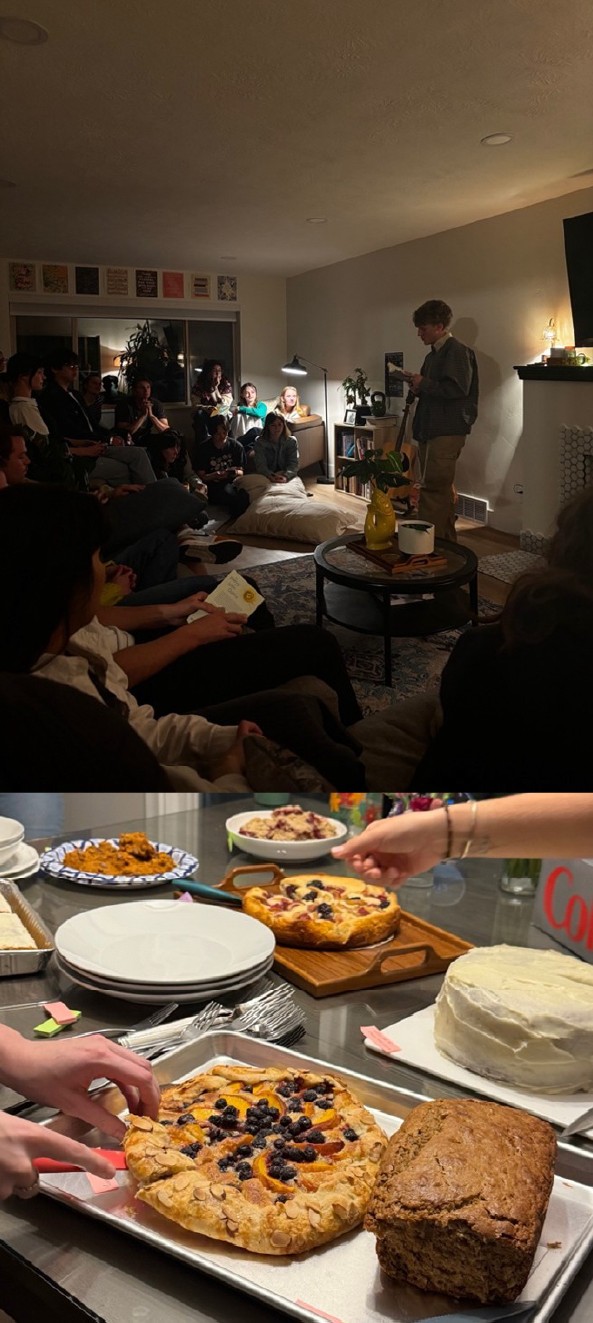
So, nowadays, everyone is invited to poetry night. People come who have never heard poetry outside of general conference, who wrote a bit on their missions and want to share it, who could recite fifteen Shakespeare sonnets on the spot, who hate poetry but want to see what all the fuss is about. People come from every major (mechanical engineering, accounting, you think of the furthest major from English and they’ve come). When strangers who find my page on Instagram (@provopeaceandpoetry), message me for my address and show up to my house on a random Sunday night ask “When can I come again? Do you do this every week?” I gape at them each time. Each time I’m flabbergasted by the ability of a genre, one I thought only for the artsy, to make people feel.
Before poetry night became a weekly event, I used to revel in the pretentiousness of knowing meter and rhyme and every little delicious device a poet used. I loved to beat poems until they were raw and bloody. And this beat me, in turn, towards a certain numbness. Explicating a poem is a great skill, but it didn’t help me to love poetry. Reading poetry out loud with other people who seek meaning and beauty taught me how to love poetry and love my life.
I don’t think poetry nights are the answer to all the contemporary plagues of Humanities departments across the world, but I do think the principle is a part of it. Public Humanities aren’t about proving why our disciplines should exist (with careers and grants and stipends and the like); our divine purpose lies in helping others understand why they exist.
If we don’t engage more with communities that need us, funding cuts may continue until Humanities programs across the country are skeletons of what they are now. This engagement may look like organizing community story nights, visiting close-by public schools, starting local literary publications, participating in library events; there are countless possibilities with our wealth of talent and resource and intellect in academia. The future of humanities disciplines depends on our decision to initiate meaningful community work that makes our area of study accessible to everyone, especially to “the least of these” (Matthew 25:40). Then, with Billy Collins, we can guide others as they “walk inside the poem’s room/and feel the walls for a light switch.”
References
Collins, Billy. “Introduction to Poetry.” The Apple that Astonished Paris. University of Arkansas Press, 1988.
MacLeish, Archibald. “Ars Poetica.” Poetry, 1926.