This post was written by Julia Morgan, a BYU Humanities Center student fellow.
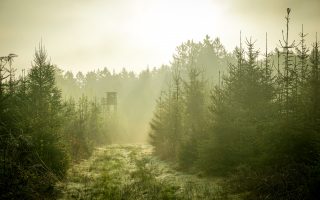
Rock Canyon is a place I visit dozens of times per year. A small canyon in Provo, characterized by quartzite, limestone, and tillite rock, Rock Canyon is a favorite among locals. But I have a controversial opinion about it: I think it’s a little ugly. Yes, winter often strips nature of its life and greenery, making everywhere less inviting, but even in summer I don’t find Rock Canyon especially spectacular. The swells of red, crumbly-looking rock and smaller cliffs make the canyon one of comparatively lesser grandeur than, say, Little Cottonwood Canyon.
I grew up at the base of Little Cottonwood, a place that millions of people visit every year. They come for everything from its spectacular wildflowers, high end ski resorts, and popular hiking trails. I love that canyon. It’s a special place for me—and that sentiment is shared with many outdoors enthusiasts. Rock Canyon does not share the same fame or widespread adoration. And this very humility of Rock Canyon is precisely why it’s so important to me. It’s not Trip Advisor’s or Instagram’s. It’s Provo’s, and it’s mine.

Rock Canyon, with its well maintained trails and frequent visitors, is not the wilderness referred to by writers like John Muir or Henry David Thoreau. The canyon can be striking, but is no Yosemite, a place adored by writers and artists for hundreds of years. Still, I’d like to think that the Rock Canyons of our world are precisely the ones that deserve our greatest attention as writers.
In his essay “The Trouble With Wilderness”, William Cronon writes about the origins of wilderness. In Biblical, mythological, and historical writings, wilderness was a place of danger where things were wild and strange. These were places where Christ was tempted, where explorers died, places where God and fear cohabitated. But Cronon argues that the writings of men like Thoreau and Muir tamed the fierce wilderness, inventing a modern Eden. These places of sacred struggle emerged suddenly as sites of preservation and recreation, giving the impression that there are places we can return to that are ‘untouched’ by human’s evil hand. These unspoiled locales formed the subject for many, if not most Romantic writers’ musings.
This is precisely the type of writing that inspired politicians like Stewart Udall and Theodore Roosevelt to create the Wilderness Act in 1964, protecting various national parks and establishing other bipartisan legislation. Muir in particular has spurred countless environmentalists and environmental movements. Yet, his vision creates an issue for those who want to be inspired by the natural world. If wilderness is far away, a place that we have to leave our cities to connect with, these places must be far removed from the trees shading our mailboxes, the ant hills on our driveways.
Cronon writes, “This, then, is the central paradox: wilderness embodies a dualistic vision in which the human is entirely outside the natural.” He wants us to remember that, while Thoreau and Muir introduced us to a transcendental vision of wilderness, we cannot forget that nature includes our own backyards. And that we, as humans, are just as much a part of the natural world as the wilderness they refer to.
Luckily, some writers have modeled this connection to our natural environments. Annie Dillard, in her book Pilgrim at Tinker Creek, shows that we don’t need to go to a national park to watch muskrats or wonder why the light catches on the river in the morning. We don’t need to take a trip to another country, or even a neighboring city, to discover a world of beauty and intrigue. She writes about the mundanity and the beauty that emerges at Tinker Creek, the river near her home.
In one shocking excerpt, Dillard writes about learning to watch frogs, to distinguish them from the grass and water. She notices one frog that is unmoving, half out of the water. She moves closer, curious, and writes: “And just as I looked at him, he slowly crumpled and began to sag. The spirit vanished from his eyes as if snuffed. His skin emptied and drooped; his very skull seemed to collapse and settle like a kicked tent. He was shrinking before my eyes like a deflating football” (7). She watches the frog’s skin turn into an empty bag, horrified. Dillard’s patience and watchfulness is clear, as she continues to return to the same river. She learns about the animals there, she muses on their significance, and constantly connects her experiences to the Bible, or Einstein, or Van Gogh. Throughout the book, Dillard returns to the frog as a metaphor, arriving at conclusions about God and the seeming cruelty of the natural world.
Dillard spends her time exploring and pondering, watching praying mantises, leaves, and often the creek itself. While the small creek near her home isn’t a noteworthy locale or the result of grand travels, she arrives at spectacularly critical questions and establishes a theodicy in prose so striking it has delighted readers for years.
Many artists have done the same as Dillard, using their home as their inspiration. These same artists, especially the Impressionists, crowd rooms and museums with admirers. The Monets, the Van Goghs: these artists spent quality time in places that might have seemed ugly or boring to their habituated eyes, painting hundreds of haystacks or variations on the light against a particular bit of a cathedral. To be an artist, we need to notice and to love what is around us.
Lately, I’ve been writing about what’s in my metaphorical backyard—since I don’t have one, I consider Provo my backyard. I write about Utah Lake and its smelly, murky warmth. I write about the Rock Canyon that is full of scrub oak and gravel. My personal favorite, the Provo River Delta, is just a three-mile loop around a shallow bend of the lake. But on my way to the delta, I pass my favorite tree. I watch it through the seasons—leaves falling, buds sprouting—and as I spend time with it, I learn about seasons and change, belonging and responsibility. I write poetry and take dozens of photos through each season. The tree stands rooted and patient as I run past it, through a breakup, a marathon, and dozens of mundane days. It reminds me that change can be quiet and slow.
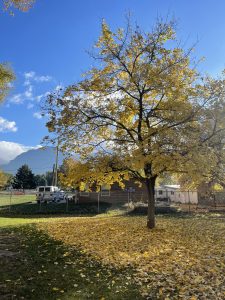
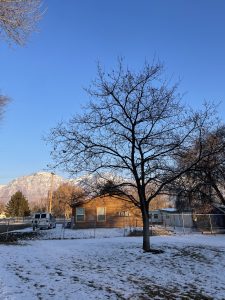
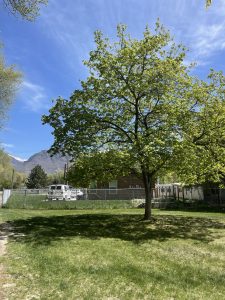
And this is just one tree, one of countless natural presences that I pass as I walk to school. I’m often overwhelmed by how much there is to learn and create from what is right here. So you and I—we need to return, after our visits to our faraway places, to our own backyards, and stoops, and skies. We need to notice them, to love them, to write about them.
And if they look a little ugly, maybe we need to stay a little longer.
References
Dillard, Annie. Pilgrim at Tinker Creek. United Kingdom, Hymns Ancient & Modern, 1974.