This post was written by Sawyer Wood, BYU Humanities Center Intern and student fellow.
While studying in Northern Spain this summer, I visited the Cathedral of Santiago de Compostela, which stands in a city literally built around its religiosity. The cathedral was constructed on a sacred site believed to be the resting place of Saint James the Great, and has served as a destination for thousands of religious pilgrims each year. These pilgrims come in droves from Spain, France, Portugal, and many other countries, some walking almost 500 miles on foot to get there. Walking “el camino” is a sacred and life-changing experience for many, and the masterwork art and architecture of the cathedral makes it hard to imagine otherwise. One of the most impressive parts of the cathedral is the entrance, the Pórtico de la Gloria, three archways adorned with awe-inspiring carvings.

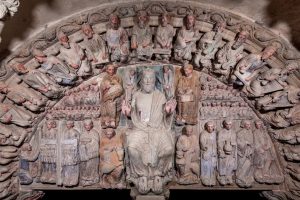
As I stood beneath the Pórtico this summer, I marveled, as many do, at the detail the artists had put into each figure. The stone boasted prophets displaying scrolls, angels leading children into heaven, and devils punishing the condemned. In the center of it all stood Christ, palms extended to show the marks in his hands, surrounded by a ring of angels and twenty-four elders with musical instruments. As I stared, one of the instruments just above Christ’s head caught my attention; it was unlike anything I’d ever seen before. It looked like an ornamented and oversized violin, but what most struck me was that it appeared to be a two-person instrument.

The instrument was an organistrum. The medieval precursor to the hurdy-gurdy, the organistrum was indeed played by two musicians — one to crank the wheel that vibrated the instrument’s strings, and another to raise the “keys” along its neck, which changed the pitch of each note. When I later visited a museum, I heard a recording of a live organistrum, and though it looked like a violin, the sound was closer to a bagpipe. If you’d like to judge its musical timbre for yourself, you can find a recording of a replica organistrum here. When I asked my professor about the instrument, she explained that the organistrum was more than a means of entertainment, it was also a metaphor for the individual’s relationship with God: you needed His help to make any music. I was entirely blown away by this explanation. I had seen the instrument as a piece of medieval trivia, something that would elicit a response like, “gee, that’s neat”, but understanding its connection to something so tangible, so human, as recognition of one’s need for divine help made the Pórtico feel so much more alive to me.
Many think of medieval art as nothing more than oversized picture books, meant for those who couldn’t read the stories from the Bible. That was how I thought about it until this summer, until the symbolism of the organistrum struck me as surprisingly insightful, and I began to study the art with a different perspective. While it’s undeniable that lowered literacy played a role in works such as the Pórtico [1], these artistic feats are also a reflection of the way people worshiped in the medieval period, which differed significantly from much of modern Christianity. While modern viewers see the Pórtico as an impressive stylistic piece, it’s likely that the worshipers at the time viewed it as something more akin to an illuminated manuscript, containing multiple symbolic layers intended for interpretation into more moving and more personal meanings. Just as the organistrum’s symbolism might prompt personal reflections centered on how one could “play the instrument of life” with God’s help, other elements served as means by which individuals could connect with, and, in some sense, worship their creator. To those in the medieval period, this worship was meant to create new feelings and experiences in the observers just as much as reading or re-reading verses of the Bible would. In the Pórtico, several symbols appear to those who know to look for them. As stated in Spaces of Knowledge: Four Dimensions of Medieval Thought,
“The presence of an organistrum…does not mean that such instrument leads any kind of concert, but that it symbolically represents the study of the language of sound, mathematical speculation and cosmological order, and the approach to the divine essence. The elders are not making music, but rather preparing themselves— some of them are tuning their instruments— both intellectually and spiritually, to face the advent of a new order of things.” [2]
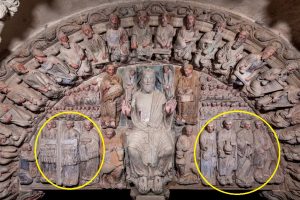
This “tuning [of] their instruments” may have been meant to elicit questions in those observing the Pórtico about whether they were sufficiently in tune with the “new order of things” (revealed in Christ’s life, death, and teachings), or if they would be ready for His return. Another layer of meaning comes from the medieval metaphor comparing the cross to a musical instrument being “played” by Jesus [3], represented very interestingly in the Pórtico. On either side of Christ’s figure, angels hold the cross, the nails, and the flask of vinegar, among other items used in the Crucifixion. These are sometimes referred to as the “arma Christi,” or instruments of the Passion [4], and their placement in the central arch, surrounded by musical instruments, bestows beautiful associations on the objects, as if the death of Christ was the plucking out of a melody, one that both mourns His suffering and celebrates His victory. Medieval scholar F. P. Pickering once wrote that “the Crucifixion [is] God’s music-making” [5], and I believe that a similar sentiment inspired the artists of the Pórtico, and can inspire observers today. The Pórtico is more than an entryway, or carvings standing over a few arches. It is a narrative, one meant to inspire new thoughts and new experiences, just as personal and powerful as those that could be read or written.
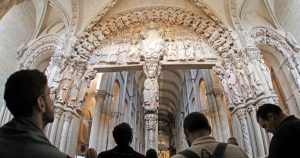
While touring cathedrals like Santiago de Compostela, there was a consistent stream of photo-taking beside the beautiful artwork, but it was rare for someone to stop long enough to make me think they were considering the layers of meaning the pieces had to offer, or what they might have meant to those who made them. It was rare for me to stop, even after I realized there was more to the art than shapes and color. It’s easy for us to look down on the illiteracy of the middle ages, but carvings like the Póritco make me wonder if we’ve become visually illiterate in our day of constant stimulation.
It’s estimated that the cathedral at Santiago de Compostela took 136 years to build [6], which means that most of those who helped in the project never saw it completed. But they thought that this artwork, these stories in stone and the experiences they’d create, were worth building cathedrals for. They were worth walking miles every day for a month until their feet ached. They were worth staring and studying and glorying about. And I can’t say I disagree.
References
[1] Letter of Gregory the Great to To Serenus Bishop of Massilia
[2] Spaces of Knowledge : Four Dimensions of Medieval Thought, edited by Noemi Barrera, et al., Cambridge Scholars Publishing, 2014. p. 39.
[3] Johnson, Holly. “God’s Music-Making: The Cross-Harp Metaphor in Late-Medieval Preaching.” Medieval Perspectives, vol. 22, Jan. 2007, pp. 48–59.
[4] “The Message of the Portico of Glory” https://catedraldesantiago.es/en/portico-de-la-gloria/
[5] Pickering, F. P. Literature and Art in the Middle Ages, The University Press, Glasgow, 1970. p. 298.
[6] “Santiago Cathedral.” dosde.com
Featured image credit: Alejandro Gangui